







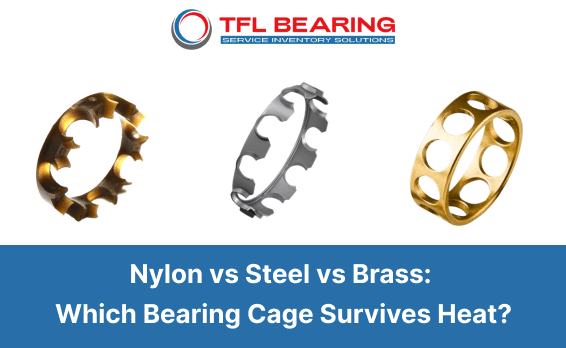
Nylon vs Steel vs Brass: Which Bearing Cage Survives Heat?
Compare Nylon (TN9), Pressed Steel, and Machined Brass (M) bearing cages under high heat. Explore 4 practical case scenarios to prevent premature cage failure.
Read articleCompare leading global bearing brands and explore compatible TFL alternatives by model, product type and application.
View all Brands GuideMatch manufacturer part numbers with interchangeable TFL bearing options and model-selection support.
Browse bearing solutions by equipment, operating environment and industry.
Practical guidance on bearing selection, applications, maintenance and sourcing.
Compare Nylon (TN9), Pressed Steel, and Machined Brass (M) bearing cages under high heat. Explore 4 practical case scenarios to prevent premature cage failure.
Read article
Find answers about quality, orders, technical support and after-sales service.
Use our articles, reference tools and customer resources to support sourcing decisions.
Learn about TFL Bearing, our quality systems and supply capabilities.
View all About & CapabilitiesAccess engineering support and services throughout the purchasing process.
View all Services & SupportExplore customer projects, sourcing partnerships and ways to contact our team.
View all Work With TFL
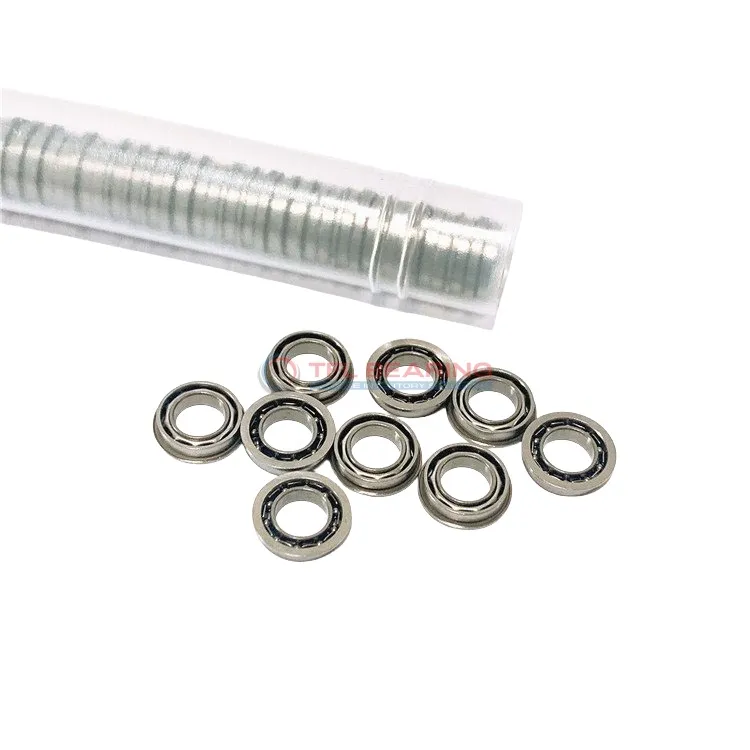
The SF691x is a small radial ball bearing with a 1.5mm bore and 5mm outer diameter, crafted entirely from stainless steel for durability. It handles radial loads up to 29 lbf and spins at impressive speeds up to 76,500 RPM.
Its open design allows for easy lubrication, while the stainless steel cage ensures smooth operation. The bearing includes a flange for secure mounting, with a flange outer diameter of 6.5mm.
With a radial clearance of 0.002mm to 0.013mm, it offers precise performance in compact spaces. Ideal for small devices like precision instruments or miniature motors where high-speed rotation is needed.
Weighing just 0.26g, it’s lightweight yet robust. Compliant with RoHS and REACH standards, it’s safe for various applications. Suitable for temperatures ranging from -30°C to 110°C.
How Does SF691x Bearing Achieve High-Speed Performance?
SF691x Bearing is crafted with stainless steel rings and balls, ensuring smooth operation at high speeds.
Its maximum speed of 76,500 rpm makes it suitable for precision applications requiring rapid rotation.
The single-row design and open seal type reduce friction, enhancing efficiency during operation.
With a dynamic radial load capacity of 29 lbf, it handles moderate loads reliably.
SF691x Bearing’s compact dimensions (1.5 mm bore, 5 mm outer diameter) make it ideal for small-scale machinery.
The stainless steel cage maintains ball alignment, contributing to long service life.
Operating within a temperature range of -30° to 110°C, SF691x Bearing performs well in varied conditions.
Its lightweight design (0.26 g) ensures minimal impact on overall system weight.
Common Applications of SF691x Bearing
SF691x Bearing is widely used in small precision instruments, such as watch movements and miniature motors, where its compact size and high-speed capability are essential. The stainless steel construction ensures durability in delicate applications.
In consumer electronics, SF691x Bearing can be found in devices like small cooling fans and handheld gadgets, providing smooth rotation with minimal noise. Its lightweight design makes it ideal for portable devices.
For medical devices, SF691x Bearing offers reliable performance in equipment like dental tools and diagnostic instruments, where precision and hygiene are critical. The open design allows for easy cleaning and maintenance.
Automation systems benefit from SF691x Bearing in components like small robotic arms and sensors, where its high-speed operation and low friction enhance efficiency. The metric sizing ensures compatibility with various international standards.
SF691x Bearing is also suitable for hobbyist projects, such as model making and DIY gadgets, due to its affordability and ease of use. The stainless steel materials provide good resistance to corrosion in various environments.