







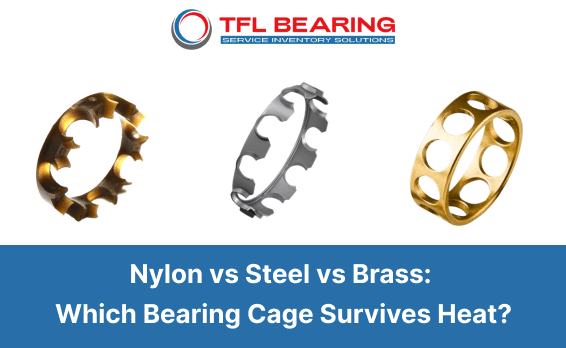
Nylon vs Steel vs Brass: Which Bearing Cage Survives Heat?
Compare Nylon (TN9), Pressed Steel, and Machined Brass (M) bearing cages under high heat. Explore 4 practical case scenarios to prevent premature cage failure.
Read articleCompare leading global bearing brands and explore compatible TFL alternatives by model, product type and application.
View all Brands GuideMatch manufacturer part numbers with interchangeable TFL bearing options and model-selection support.
Browse bearing solutions by equipment, operating environment and industry.
Practical guidance on bearing selection, applications, maintenance and sourcing.
Compare Nylon (TN9), Pressed Steel, and Machined Brass (M) bearing cages under high heat. Explore 4 practical case scenarios to prevent premature cage failure.
Read article
Find answers about quality, orders, technical support and after-sales service.
Use our articles, reference tools and customer resources to support sourcing decisions.
Learn about TFL Bearing, our quality systems and supply capabilities.
View all About & CapabilitiesAccess engineering support and services throughout the purchasing process.
View all Services & SupportExplore customer projects, sourcing partnerships and ways to contact our team.
View all Work With TFL
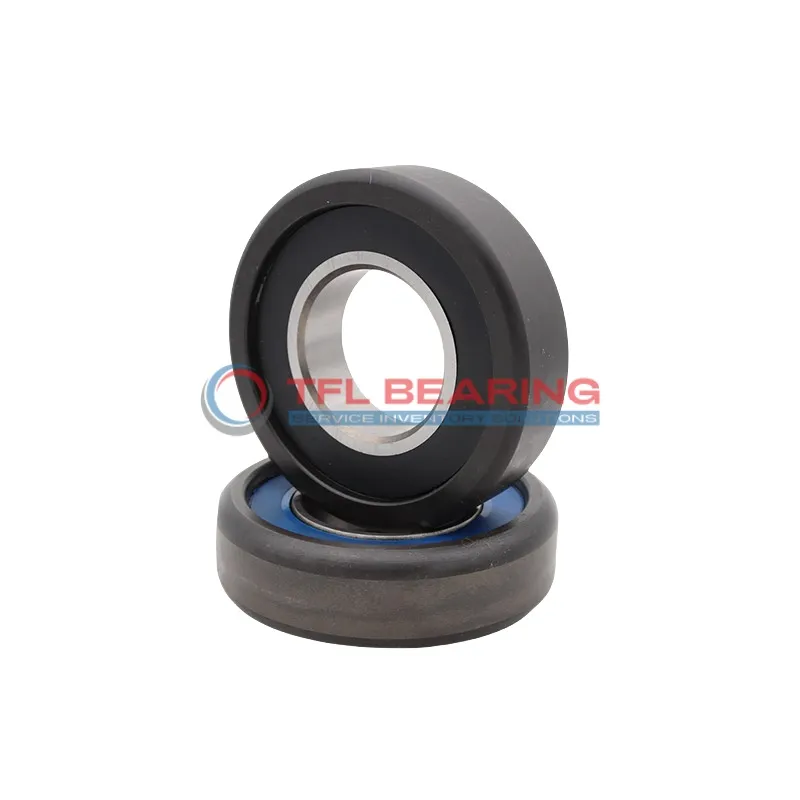
The MG 307 FFN‑9 is a mast guide bearing with a 35mm inner diameter and 105.5mm outer diameter, designed for sturdy performance. It handles dynamic loads up to 33,540 N and static loads up to 19,230 N, making it reliable for heavy-duty use.
Its compact design, with a width of 28mm and a 6mm radius, ensures easy integration into tight spaces. The bearing’s robust construction provides durability in demanding conditions.
Weighing 1.3381 kg, it’s a solid choice for applications like construction equipment or industrial machinery. Its balanced weight and strength make it suitable for both stationary and moving parts.
This bearing is ideal for guiding masts or similar structures where precision and load capacity are key. Its interchangeable nature with OEM parts adds to its versatility.
Why Choose MG 307 FFN‑9 Bearing for Precision Tasks?
MG 307 FFN‑9 Bearing features a robust design with an inner diameter of 35.000 mm and an outer diameter of 105.50 mm, ensuring precise alignment in guide applications.
Its dynamic capacity of 33,540 N and static capacity of 19,230 N make it suitable for handling significant loads with reliability.
The bearing’s dimensions (35.000 mm x 105.50 mm x 28.000 mm) and weight of 1.3381 Kg ensure it fits seamlessly into various machinery setups.
With a radius of 6 mm, it offers smooth operation and reduced stress concentrations.
Industrial Uses of MG 307 FFN‑9 Bearing
MG 307 FFN‑9 Bearing is commonly used in heavy machinery, such as cranes and lifts, where its high dynamic capacity ensures reliable performance under substantial loads. The robust design makes it suitable for environments demanding durability and precision.
In automotive applications, MG 307 FFN‑9 Bearing supports components like steering systems and transmissions, providing smooth operation even under continuous stress. Its precise dimensions and weight distribution contribute to enhanced vehicle stability.
For automation systems, MG 307 FFN‑9 Bearing is ideal for robotic arms and conveyor belts, thanks to its balanced load handling and resistance to wear. The stainless steel construction ensures longevity in high-use industrial settings.
Key Fields for MG 307 FFN‑9 Bearing
MG 307 FFN‑9 Bearing excels in construction equipment, where its static capacity handles heavy axial loads in excavators and bulldozers. The inner and outer ring widths provide optimal support for prolonged use.
In agricultural machinery, MG 307 FFN‑9 Bearing is favoured for its ability to withstand harsh conditions, such as in tractors and harvesters. The radius design reduces friction, improving efficiency in field operations.
For material handling systems, MG 307 FFN‑9 Bearing ensures smooth movement in forklifts and pallet jacks. Its weight and dimensions make it a practical choice for equipment requiring both strength and precision.