







How Hot Is Too Hot for a Bearing?
Learn why bearing overheating has no universal temperature limit, how to read temperature trends, and when a hot bearing needs investigation or shutdown.
Read articleCompare leading global bearing brands and explore compatible TFL alternatives by model, product type and application.
View all Brands GuideMatch manufacturer part numbers with interchangeable TFL bearing options and model-selection support.
Browse bearing solutions by equipment, operating environment and industry.
Practical guidance on bearing selection, applications, maintenance and sourcing.
Learn why bearing overheating has no universal temperature limit, how to read temperature trends, and when a hot bearing needs investigation or shutdown.
Read article
Find answers about quality, orders, technical support and after-sales service.
Use our articles, reference tools and customer resources to support sourcing decisions.
Learn about TFL Bearing, our quality systems and supply capabilities.
View all About & CapabilitiesAccess engineering support and services throughout the purchasing process.
View all Services & SupportExplore customer projects, sourcing partnerships and ways to contact our team.
View all Work With TFL
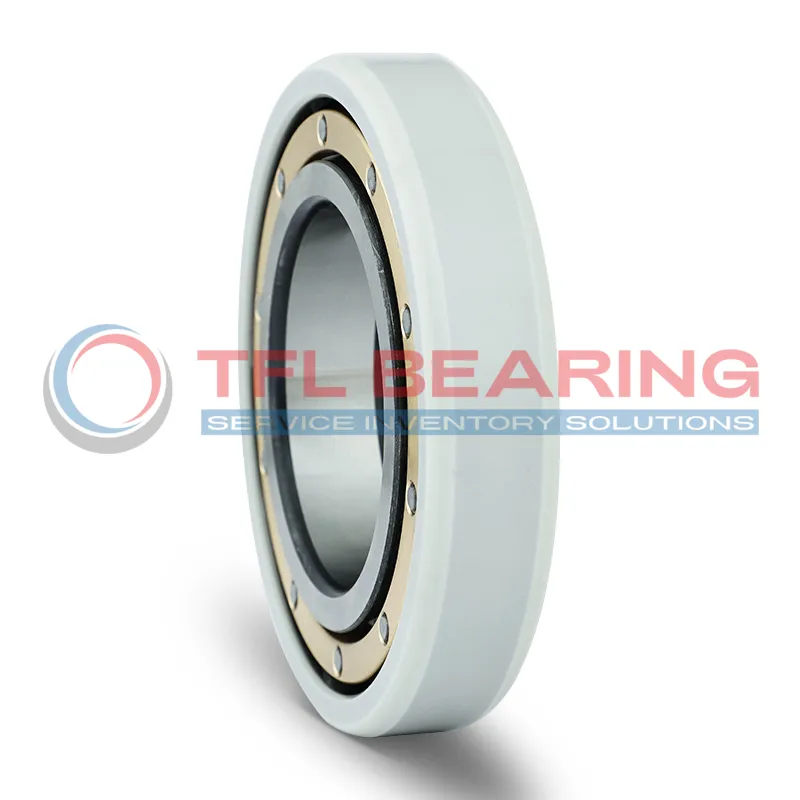
The NUP218-E-XL-M1-F1-J20AA-C3 is a current-insulated cylindrical roller bearing with a 90mm bore and 160mm outer diameter, designed to prevent electrical damage. Its outer ring features a ceramic coating, providing insulation up to 1000V DC.
With a dynamic load rating of 215 kN and a static load rating of 217 kN, it handles heavy loads efficiently. The brass cage ensures smooth operation at speeds up to 3900 rpm.
The C3 radial clearance allows for thermal expansion, making it suitable for high-temperature environments. Its insulation properties remain effective even in damp conditions, with a resistance of 10MΩ.
Ideal for electric motors or generators, this bearing prevents current passage that could cause damage. Compliant with RoHS and REACH standards, it’s a reliable choice for industrial applications. Weighing 2.6kg, it balances durability with practicality.
How Does NUP218-E-XL-M1-F1-J20AA-C3 Bearing Resist Wear?
NUP218-E-XL-M1-F1-J20AA-C3 Bearing features a brass cage that enhances durability and reduces wear during operation.
The ceramic coating on the outer ring provides excellent insulation, protecting against electrical currents.
With a basic dynamic load rating of 215 kN, it handles heavy loads efficiently.
Its reference speed of 3900r/min ensures smooth performance in high-speed applications.
The C3 radial internal clearance allows for thermal expansion, maintaining reliability.
This design makes NUP218-E-XL-M1-F1-J20AA-C3 Bearing suitable for demanding industrial environments.
Industrial Uses of NUP218-E-XL-M1-F1-J20AA-C3 Bearing
NUP218-E-XL-M1-F1-J20AA-C3 Bearing is commonly used in electric motors and generators, where its current-insulating coating prevents electrical damage. The brass cage ensures smooth operation even under high rotational speeds.
What Makes NUP218-E-XL-M1-F1-J20AA-C3 Bearing a Preferred Choice?
In wind turbines, NUP218-E-XL-M1-F1-J20AA-C3 Bearing handles heavy radial loads while its ceramic coating protects against stray currents. The C3 clearance allows for thermal expansion in demanding environments.
Built for Heavy-Duty Use: NUP218-E-XL-M1-F1-J20AA-C3 Bearing
NUP218-E-XL-M1-F1-J20AA-C3 Bearing excels in industrial gearboxes, where its high dynamic load rating ensures long service life. The 200 um insulating layer provides reliable protection in damp conditions.
Medical vs Industrial: Where NUP218-E-XL-M1-F1-J20AA-C3 Bearing Excels
While not typically used in medical devices, NUP218-E-XL-M1-F1-J20AA-C3 Bearing shines in factory automation equipment like conveyor systems. Its 3900r/min reference speed suits high-performance machinery.
Key Fields for NUP218-E-XL-M1-F1-J20AA-C3 Bearing
NUP218-E-XL-M1-F1-J20AA-C3 Bearing is ideal for railway applications, where electrical insulation prevents damage from track currents. The 217 kN static load rating handles heavy shock loads effectively.