







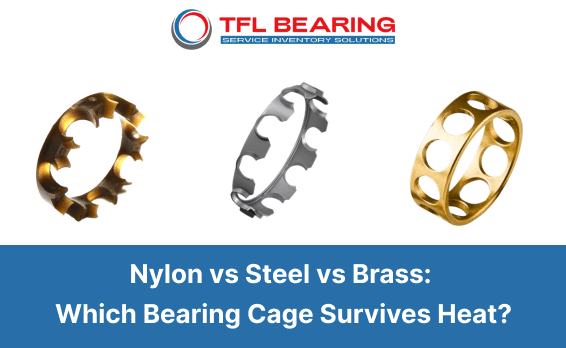
Nylon vs Steel vs Brass: Which Bearing Cage Survives Heat?
Compare Nylon (TN9), Pressed Steel, and Machined Brass (M) bearing cages under high heat. Explore 4 practical case scenarios to prevent premature cage failure.
Read articleCompare leading global bearing brands and explore compatible TFL alternatives by model, product type and application.
View all Brands GuideMatch manufacturer part numbers with interchangeable TFL bearing options and model-selection support.
Browse bearing solutions by equipment, operating environment and industry.
Practical guidance on bearing selection, applications, maintenance and sourcing.
Compare Nylon (TN9), Pressed Steel, and Machined Brass (M) bearing cages under high heat. Explore 4 practical case scenarios to prevent premature cage failure.
Read article
Find answers about quality, orders, technical support and after-sales service.
Use our articles, reference tools and customer resources to support sourcing decisions.
Learn about TFL Bearing, our quality systems and supply capabilities.
View all About & CapabilitiesAccess engineering support and services throughout the purchasing process.
View all Services & SupportExplore customer projects, sourcing partnerships and ways to contact our team.
View all Work With TFL
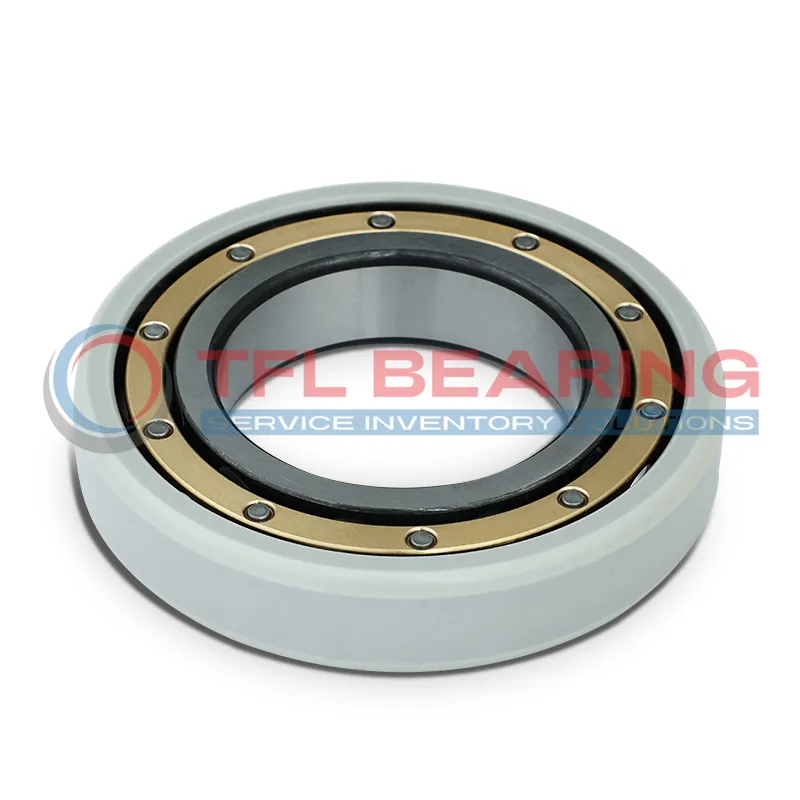
The FAG NU226-E-XL-M1-J20AA is a current-insulated cylindrical roller bearing, measuring 130mm by 230mm by 40mm, with a ceramic-coated outer ring for electrical insulation. It handles dynamic loads up to 425 kN and static loads up to 445 kN, suitable for high-speed applications up to 2800 RPM.
Its brass cage ensures durability, while the ceramic coating provides insulation with a breakdown voltage of up to 1000V, ideal for preventing electrical damage. The bearing operates reliably in damp conditions, maintaining an electrical resistance of 10MΩ.
With a normal radial internal clearance (Cn), it offers smooth performance in demanding environments. Compliant with RoHS and REACH standards, it’s a safe choice for industrial use.
Weighing 7.95kg, this bearing is robust yet manageable for installations in electric motors or generators where electrical insulation is critical.
How Is NU226-E-XL-M1-J20AA Bearing Engineered for Reliability?
NU226-E-XL-M1-J20AA Bearing features an outer ring ceramic coating, providing excellent current insulation.
This design prevents electrical arcing, ensuring reliable operation in electrically charged environments.
The brass cage maintains proper roller alignment, reducing friction and wear.
With a basic dynamic load rating of 425 kN, it handles heavy radial loads with ease.
NU226-E-XL-M1-J20AA Bearing operates smoothly up to 2800r/min, balancing speed and durability.
Its normal internal play (Cn) ensures optimal performance under varying thermal conditions.
The coating offers high electrical resistance, with 50MΩ when dry and 10MΩ in damp conditions.
This makes NU226-E-XL-M1-J20AA Bearing suitable for diverse industrial applications.
Industrial Uses of NU226-E-XL-M1-J20AA Bearing
NU226-E-XL-M1-J20AA Bearing is commonly used in electric motors and generators, where its current-insulating coating prevents electrical damage. The brass cage ensures smooth operation even under high rotational speeds.
What Makes NU226-E-XL-M1-J20AA Bearing a Preferred Choice?
In wind turbines, NU226-E-XL-M1-J20AA Bearing handles heavy radial loads while its ceramic coating protects against stray currents. Its durability makes it suitable for long-term use in harsh environments.
Built for Heavy-Duty Use: NU226-E-XL-M1-J20AA Bearing
NU226-E-XL-M1-J20AA Bearing is ideal for industrial gearboxes, where its high dynamic load rating ensures reliable performance. The normal internal play allows for thermal expansion during operation.
Automotive vs Aerospace: Applications of NU226-E-XL-M1-J20AA Bearing
In automotive applications, NU226-E-XL-M1-J20AA Bearing supports drivetrain components, while in aerospace, it’s used in auxiliary power units. The insulating properties are crucial in both fields.
Perfect Fit for Automation: NU226-E-XL-M1-J20AA Bearing
NU226-E-XL-M1-J20AA Bearing is often found in robotic arms, where precision and electrical insulation are key. Its compact design fits well in space-constrained automation systems.