







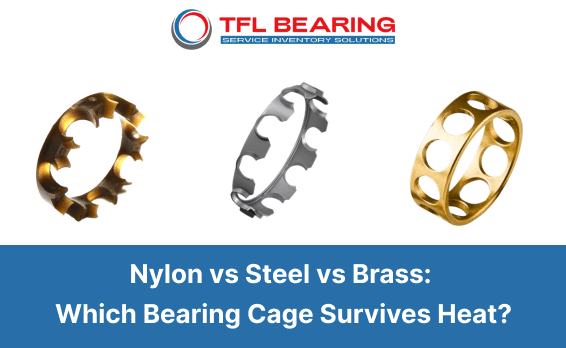
Nylon vs Steel vs Brass: Which Bearing Cage Survives Heat?
Compare Nylon (TN9), Pressed Steel, and Machined Brass (M) bearing cages under high heat. Explore 4 practical case scenarios to prevent premature cage failure.
Read articleCompare leading global bearing brands and explore compatible TFL alternatives by model, product type and application.
View all Brands GuideMatch manufacturer part numbers with interchangeable TFL bearing options and model-selection support.
Browse bearing solutions by equipment, operating environment and industry.
Practical guidance on bearing selection, applications, maintenance and sourcing.
Compare Nylon (TN9), Pressed Steel, and Machined Brass (M) bearing cages under high heat. Explore 4 practical case scenarios to prevent premature cage failure.
Read article
Find answers about quality, orders, technical support and after-sales service.
Use our articles, reference tools and customer resources to support sourcing decisions.
Learn about TFL Bearing, our quality systems and supply capabilities.
View all About & CapabilitiesAccess engineering support and services throughout the purchasing process.
View all Services & SupportExplore customer projects, sourcing partnerships and ways to contact our team.
View all Work With TFL-Bearings-ND120XP0-Dimensions.webp)
The ND120XP0 is a thin-section ball bearing with a 12″ bore and 13″ outer diameter, featuring a compact width of just 0.5″. Made from chrome steel with a brass cage, it offers durability and smooth operation.
This four-point contact bearing handles radial loads up to 4178 lbf and thrust loads up to 6950 lbf, making it versatile for various applications. Its ABEC-1 tolerance ensures reliable performance in precision settings.
The open design allows easy lubrication, while the chromium plating enhances corrosion resistance. It operates well in temperatures from -30°C to 110°C.
Ideal for robotics, medical equipment, or aerospace applications where space is limited but performance is critical. Weighing 2.25 lbs, it’s lightweight yet robust for its size. Compliant with RoHS standards for safe use.
How Does ND120XP0 Bearing Handle Heavy Loads?
ND120XP0 Bearing is built with chrome steel rings and balls, offering strong resistance to heavy loads.
Its dynamic radial load capacity reaches 4178 lbf, ensuring reliable performance in demanding applications.
The brass cage maintains ball alignment, reducing wear and extending service life.
With a static thrust load of 21380 lbf, it balances durability and efficiency.
Technical Highlights of ND120XP0 Bearing
ND120XP0 Bearing features a thin-section design with chromium plating, enhancing corrosion resistance.
The ABEC-1 tolerance ensures consistent performance in precision applications.
Its four-point contact design allows for smooth operation under radial and moment loads.
The bearing operates efficiently within a temperature range of -30°C to 110°C.
Why Choose ND120XP0 Bearing for Precision Tasks?
ND120XP0 Bearing’s chrome steel construction provides high precision and durability.
With a radial clearance of 0.0000 – 0.0005″, it ensures minimal vibration and noise.
The brass cage offers excellent stability, even under high moment loads.
Its compact 0.5″ width makes it suitable for space-constrained applications.
Key Fields for ND120XP0 Bearing
ND120XP0 Bearing is commonly used in industrial robotics, where its thin-section design saves space without compromising load capacity. The chromium plating offers added protection in environments with moderate corrosion risks.
In aerospace applications, ND120XP0 Bearing’s four-point contact design handles combined radial and thrust loads efficiently. Its ABEC-1 tolerance ensures reliable performance in precision flight control systems.
For medical imaging devices, ND120XP0 Bearing’s brass cage reduces friction, enabling smooth rotation in sensitive equipment. The chrome steel construction maintains stability during prolonged use.
Automation systems benefit from ND120XP0 Bearing’s lightweight build and moment load rating, ideal for articulated arms. The inch sizing simplifies integration with North American machinery standards.