







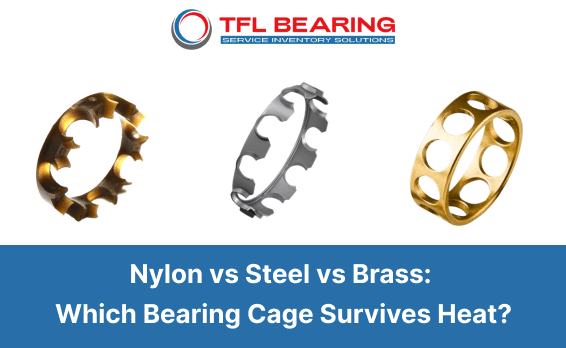
Nylon vs Steel vs Brass: Which Bearing Cage Survives Heat?
Compare Nylon (TN9), Pressed Steel, and Machined Brass (M) bearing cages under high heat. Explore 4 practical case scenarios to prevent premature cage failure.
Read articleCompare leading global bearing brands and explore compatible TFL alternatives by model, product type and application.
View all Brands GuideMatch manufacturer part numbers with interchangeable TFL bearing options and model-selection support.
Browse bearing solutions by equipment, operating environment and industry.
Practical guidance on bearing selection, applications, maintenance and sourcing.
Compare Nylon (TN9), Pressed Steel, and Machined Brass (M) bearing cages under high heat. Explore 4 practical case scenarios to prevent premature cage failure.
Read article
Find answers about quality, orders, technical support and after-sales service.
Use our articles, reference tools and customer resources to support sourcing decisions.
Learn about TFL Bearing, our quality systems and supply capabilities.
View all About & CapabilitiesAccess engineering support and services throughout the purchasing process.
View all Services & SupportExplore customer projects, sourcing partnerships and ways to contact our team.
View all Work With TFL-Bearings-NB180AR0-Dimensions.webp)
The NB180AR0 is a constant section bearing with an 18″ bore and 18.625″ outer diameter, featuring a slim 0.3125″ width. Made from chrome steel with brass cage, it’s built for angular contact loads and offers smooth operation.
This bearing handles dynamic radial loads up to 2038 lbf and static loads up to 8660 lbf, with a 30° contact angle for stability. Its open design allows easy lubrication, and it works in temperatures from -30°C to 110°C.
The thin-section design saves space without sacrificing strength, while the chromium plating adds corrosion resistance. It’s interchangeable with KAYDON bearings, making replacements straightforward.
Ideal for applications requiring precise motion control, like robotics or aerospace systems. Weighing 1.26 lbs, it’s lightweight yet durable for its size. Compliant with RoHS standards for safe use.
How Is NB180AR0 Bearing Engineered for Reliability?
NB180AR0 Bearing features a single-row angular contact design, optimised for handling both radial and thrust loads.
The chrome steel rings and balls provide durability, while the brass cage ensures smooth operation.
With a dynamic radial load capacity of 2038 lbf, NB180AR0 Bearing performs reliably in demanding conditions.
Its ABEC-1 tolerance class ensures consistent precision, suitable for various applications.
The 30° contact angle enhances load distribution, reducing wear over time.
NB180AR0 Bearing operates smoothly within a temperature range of -30°C to 110°C.
Designed for easy lubrication, NB180AR0 Bearing requires minimal maintenance.
Its chromium-plated surface adds an extra layer of protection against corrosion.
Industrial Uses of NB180AR0 Bearing
NB180AR0 Bearing is commonly used in industrial machinery where space is limited but precision is key, such as robotic arms and packaging equipment. Its thin-section design allows for compact installations without sacrificing performance.
What Makes NB180AR0 Bearing a Preferred Choice?
In automation systems, NB180AR0 Bearing excels in applications like rotary tables and indexing devices, thanks to its angular contact design. The brass cage ensures smooth operation even under moderate loads.
Built for Heavy-Duty Use: NB180AR0 Bearing
For aerospace applications, NB180AR0 Bearing provides reliable performance in control mechanisms and landing gear systems. Its chromium plating offers extra protection against corrosion in harsh environments.
Medical vs Industrial: Where NB180AR0 Bearing Excels
In medical imaging devices, NB180AR0 Bearing’s precision ensures accurate positioning of components. Meanwhile, in industrial settings, it handles moment loads effectively in turntables and swivel joints.
Essential Roles of NB180AR0 Bearing
NB180AR0 Bearing is a go-to for applications requiring low friction and high rigidity, such as telescope mounts and radar systems. Its ABEC-1 tolerance class makes it suitable for general precision needs.