







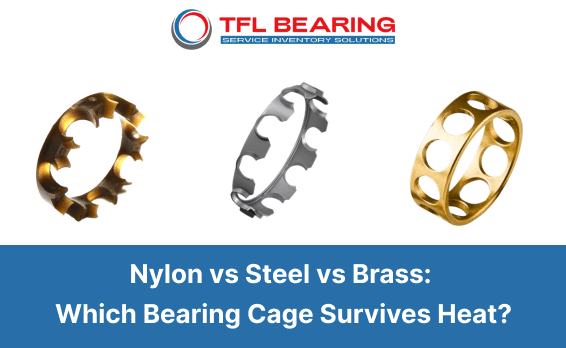
Nylon vs Steel vs Brass: Which Bearing Cage Survives Heat?
Compare Nylon (TN9), Pressed Steel, and Machined Brass (M) bearing cages under high heat. Explore 4 practical case scenarios to prevent premature cage failure.
Read articleCompare leading global bearing brands and explore compatible TFL alternatives by model, product type and application.
View all Brands GuideMatch manufacturer part numbers with interchangeable TFL bearing options and model-selection support.
Browse bearing solutions by equipment, operating environment and industry.
Practical guidance on bearing selection, applications, maintenance and sourcing.
Compare Nylon (TN9), Pressed Steel, and Machined Brass (M) bearing cages under high heat. Explore 4 practical case scenarios to prevent premature cage failure.
Read article
Find answers about quality, orders, technical support and after-sales service.
Use our articles, reference tools and customer resources to support sourcing decisions.
Learn about TFL Bearing, our quality systems and supply capabilities.
View all About & CapabilitiesAccess engineering support and services throughout the purchasing process.
View all Services & SupportExplore customer projects, sourcing partnerships and ways to contact our team.
View all Work With TFL
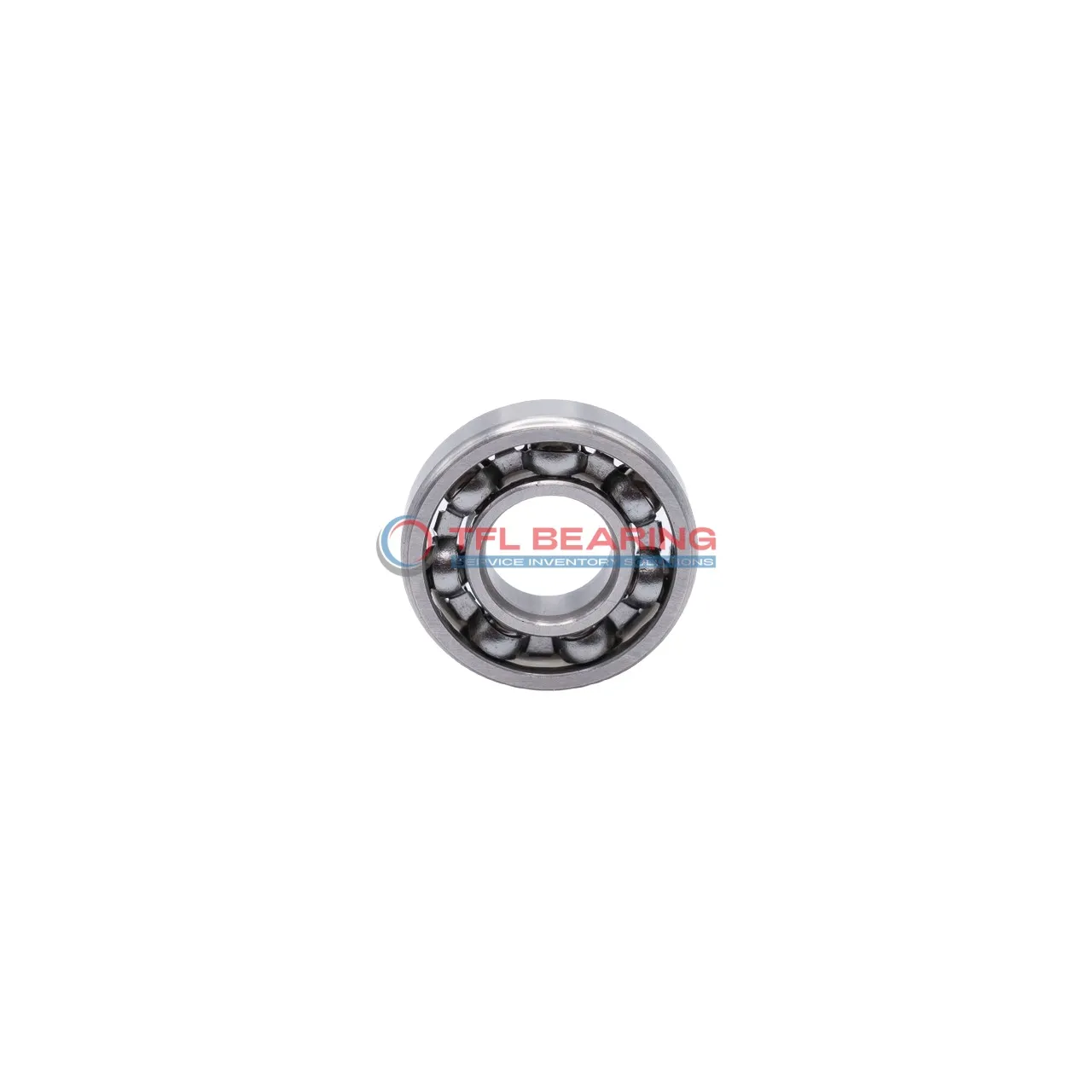
The SR1-5 is a miniature ball bearing with a compact size of 0.09375″×0.3125″×0.1094″, made entirely from stainless steel for durability. It handles radial loads up to 95 lbf and spins smoothly at speeds up to 54,000 RPM.
Its open design requires lubrication but allows for easy maintenance, while the stainless steel cage ensures consistent performance. The bearing operates well in temperatures from -86°F to 230°F.
With an ABEC1 tolerance class, it offers reliable precision for small-scale applications. Ideal for use in miniature machinery, precision instruments, or small electric motors.
Weighing just 0.6g, it’s lightweight yet sturdy. Compliant with RoHS and REACH standards for safe and versatile use.
Why Choose SR1-5 Bearing for Precision Tasks?
SR1-5 Bearing is crafted with stainless steel rings and balls, ensuring precise performance in miniature applications.
Its ABEC1 tolerance class guarantees consistent accuracy, making it suitable for delicate instruments.
The open design allows for easy lubrication, maintaining smooth operation over time.
With a maximum speed of 54,000 rpm, it delivers reliable performance in high-speed scenarios.
SR1-5 Bearing’s compact size and lightweight construction make it ideal for space-constrained applications.
The stainless steel cage ensures durability, even in demanding environments.
Industrial Uses of SR1-5 Bearing
SR1-5 Bearing is commonly used in small industrial equipment like precision instruments and miniature gear systems. Its stainless steel construction ensures durability in environments where corrosion resistance is important.
The open design allows for easy lubrication, making it suitable for applications requiring frequent maintenance. With its compact size, SR1-5 Bearing fits well in tight spaces without compromising performance.
Where Is SR1-5 Bearing Used?
You’ll often find SR1-5 Bearing in medical devices such as dental tools or lab equipment, where its precision and smooth operation are key. The ABEC1 tolerance ensures reliable performance in these sensitive applications.
Its lightweight design also makes it a good fit for small consumer electronics like miniature fans or handheld gadgets. The stainless steel balls and rings provide long-lasting use even with constant movement.
Built for Heavy-Duty Use: SR1-5 Bearing
SR1-5 Bearing handles radial loads efficiently in applications like small motors or robotic joints. Its high-speed capability, up to 54,000 rpm, makes it versatile for dynamic systems.
The MC3 radial clearance offers a balance between smooth operation and load capacity. Whether in automation or light machinery, SR1-5 Bearing delivers consistent performance.
Automotive vs Aerospace: Applications of SR1-5 Bearing
In automotive systems, SR1-5 Bearing is used in small actuators or sensors due to its compact size and reliability. The inch measurements make it compatible with various American-designed components.
For aerospace applications, its lightweight and temperature resistance suit it for instrumentation panels or drone mechanisms. The stainless steel material ensures it can handle varying conditions without wear.