







Nylon vs Steel vs Brass: Which Bearing Cage Survives Heat?
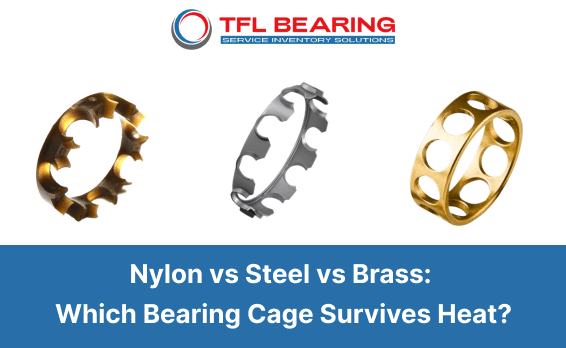
Compare Nylon (TN9), Pressed Steel, and Machined Brass (M) bearing cages under high heat. Explore 4 practical case scenarios to prevent premature cage failure.
Read articleCompare leading global bearing brands and explore compatible TFL alternatives by model, product type and application.
View all Brands GuideMatch manufacturer part numbers with interchangeable TFL bearing options and model-selection support.
Browse bearing solutions by equipment, operating environment and industry.
Practical guidance on bearing selection, applications, maintenance and sourcing.
Compare Nylon (TN9), Pressed Steel, and Machined Brass (M) bearing cages under high heat. Explore 4 practical case scenarios to prevent premature cage failure.
Read article
Find answers about quality, orders, technical support and after-sales service.
Use our articles, reference tools and customer resources to support sourcing decisions.
Learn about TFL Bearing, our quality systems and supply capabilities.
View all About & CapabilitiesAccess engineering support and services throughout the purchasing process.
View all Services & SupportExplore customer projects, sourcing partnerships and ways to contact our team.
View all Work With TFL-Bearings-NA020CP0-Dimensions.webp)
Why Choose NA020CP0 Bearing for Precision Tasks?
NA020CP0 Bearing features a thin-section design with chromium plating, ideal for applications requiring precise radial load handling.
Its ABEC-1 tolerance ensures consistent performance, while the brass cage maintains smooth ball alignment.
The chrome steel construction provides durability, supporting dynamic radial loads up to 393 lbf.
With a temperature range of -30°C to 110°C, it performs reliably in varied conditions.
NA020CP0 Bearing’s compact 0.25″ width saves space without compromising strength.
Its open design simplifies installation, making it a practical choice for precision machinery.
Industrial Uses of NA020CP0 Bearing
NA020CP0 Bearing is commonly used in industrial machinery where space is limited, such as robotic arms and packaging equipment. Its thin-section design ensures it fits snugly without compromising performance.
Where Is NA020CP0 Bearing Used?
You’ll often find NA020CP0 Bearing in automation systems, particularly in conveyor belts and rotary tables. Its chromium plating adds durability, making it suitable for high-use environments.
Built for Heavy-Duty Use: NA020CP0 Bearing
NA020CP0 Bearing handles radial loads effortlessly in applications like printing presses and textile machines. The brass cage provides smooth operation, even under continuous use.
Automotive vs Aerospace: Applications of NA020CP0 Bearing
In automotive systems, NA020CP0 Bearing supports steering columns and gear mechanisms. For aerospace, its lightweight design is ideal for instrumentation panels and control systems.
Perfect Fit for Automation: NA020CP0 Bearing
NA020CP0 Bearing works well in 3D printers and CNC machines, where precision is key. The ABEC-1 tolerance ensures reliable performance in these demanding applications.
Industrial Uses of NA020CP0 Bearing
NA020CP0 Bearing is commonly used in industrial machinery where space is limited, such as robotic arms and packaging equipment. Its thin-section design ensures it fits snugly without compromising performance.
Where Is NA020CP0 Bearing Used?
You’ll often find NA020CP0 Bearing in automation systems, particularly in conveyor belts and rotary tables. Its chromium plating adds durability, making it suitable for high-use environments.
Built for Heavy-Duty Use: NA020CP0 Bearing
NA020CP0 Bearing handles radial loads effortlessly in applications like printing presses and textile machines. The brass cage provides smooth operation, even under continuous use.
Automotive vs Aerospace: Applications of NA020CP0 Bearing
In automotive systems, NA020CP0 Bearing supports steering columns and gear mechanisms. For aerospace, its lightweight design is ideal for instrumentation panels and control systems.
Perfect Fit for Automation: NA020CP0 Bearing
NA020CP0 Bearing works well in 3D printers and CNC machines, where precision is key. The ABEC-1 tolerance ensures reliable performance in these demanding applications.