







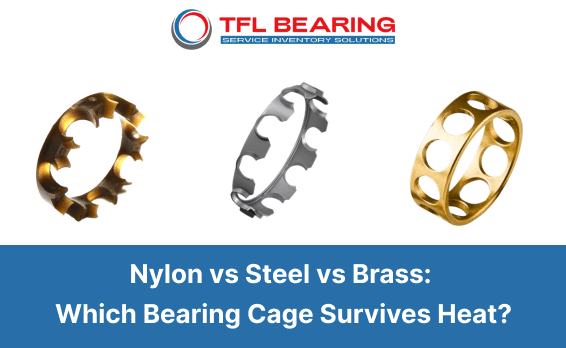
Nylon vs Steel vs Brass: Which Bearing Cage Survives Heat?
Compare Nylon (TN9), Pressed Steel, and Machined Brass (M) bearing cages under high heat. Explore 4 practical case scenarios to prevent premature cage failure.
Read articleCompare leading global bearing brands and explore compatible TFL alternatives by model, product type and application.
View all Brands GuideMatch manufacturer part numbers with interchangeable TFL bearing options and model-selection support.
Browse bearing solutions by equipment, operating environment and industry.
Practical guidance on bearing selection, applications, maintenance and sourcing.
Compare Nylon (TN9), Pressed Steel, and Machined Brass (M) bearing cages under high heat. Explore 4 practical case scenarios to prevent premature cage failure.
Read article
Find answers about quality, orders, technical support and after-sales service.
Use our articles, reference tools and customer resources to support sourcing decisions.
Learn about TFL Bearing, our quality systems and supply capabilities.
View all About & CapabilitiesAccess engineering support and services throughout the purchasing process.
View all Services & SupportExplore customer projects, sourcing partnerships and ways to contact our team.
View all Work With TFL (Imperial)/2581-2523D-TDO-(Two-Row-Double-Outer-Race)-(Imperial)-Dimensions.webp)
The 2581-2523D is a double-row tapered roller bearing with a 1.3125″ bore and 2.75″ outer diameter, built from sturdy chrome steel. It handles combined loads up to 32800 lbf and is designed for long-lasting performance.
Its open design allows easy lubrication, while the steel cage ensures smooth operation. The bearing works in temperatures from -30°C to 110°C, making it versatile for various conditions.
This model fits standard 2500 series applications and comes with standard radial clearance. Ideal for heavy-duty machinery or automotive uses where combined loads are common.
Weighing 2.43 lb, it’s robust yet manageable for its size. Compliant with RoHS and REACH standards for safe use.
How Does 2581-2523D Bearing Handle Combined Loads?
2581-2523D Bearing features a double-row tapered roller design, ideal for handling both radial and thrust loads.
Its chrome steel construction ensures durability, with a dynamic radial load capacity of 32,800 lbf.
The steel cage maintains roller alignment, reducing friction and extending service life.
With standard radial clearance options, it offers flexibility for various applications.
2581-2523D Bearing operates efficiently within a temperature range of -30° to 110°C.
Its open design allows for easy lubrication, ensuring smooth performance over time.
The precise tolerances of 2581-2523D Bearing contribute to its reliable operation.
Weighing just 2.43 lb, it balances strength and portability for industrial use.
Industrial Uses of 2581-2523D Bearing
2581-2523D Bearing is commonly used in heavy machinery, such as construction equipment and mining tools, where its double-row design handles combined radial and thrust loads efficiently. The chrome steel construction ensures durability in demanding environments.
Where Is 2581-2523D Bearing Used?
You’ll often find 2581-2523D Bearing in automotive applications like truck wheel hubs, where its tapered roller design provides smooth performance under heavy loads. The inch sizing makes it a popular choice for North American vehicles.
Built for Heavy-Duty Use: 2581-2523D Bearing
2581-2523D Bearing excels in industrial gearboxes, offering reliable performance even under continuous operation. Its open design allows for easy lubrication, extending service life in high-stress conditions.
Automotive vs Aerospace: Applications of 2581-2523D Bearing
In automotive systems, 2581-2523D Bearing supports heavy axles and transmissions, while in aerospace, it’s used in landing gear mechanisms. The standard radial clearance ensures versatility across different load requirements.
Perfect Fit for Automation: 2581-2523D Bearing
2581-2523D Bearing works well in automated conveyor systems, where its double-row construction maintains alignment under varying loads. The steel cage adds stability, reducing wear over time.