







6201 Bearing: Dimensions, Specs, Seal Types and Replacement Guide
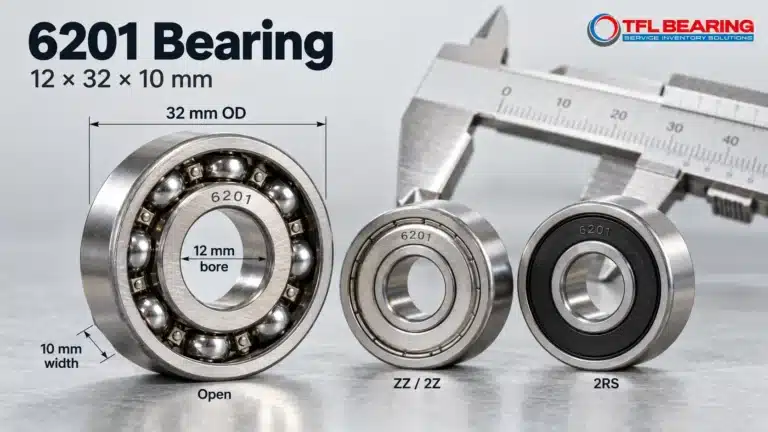
A 6201 bearing is a single row deep groove ball bearing with a 12 mm bore, a 32 mm outside diameter and a 10…
Read articleCompare leading global bearing brands and explore compatible TFL alternatives by model, product type and application.
View all Brands GuideMatch manufacturer part numbers with interchangeable TFL bearing options and model-selection support.
Browse bearing solutions by equipment, operating environment and industry.
Practical guidance on bearing selection, applications, maintenance and sourcing.
A 6201 bearing is a single row deep groove ball bearing with a 12 mm bore, a 32 mm outside diameter and a 10…
Read article
Find answers about quality, orders, technical support and after-sales service.
Use our articles, reference tools and customer resources to support sourcing decisions.
Learn about TFL Bearing, our quality systems and supply capabilities.
View all About & CapabilitiesAccess engineering support and services throughout the purchasing process.
View all Services & SupportExplore customer projects, sourcing partnerships and ways to contact our team.
View all Work With TFL
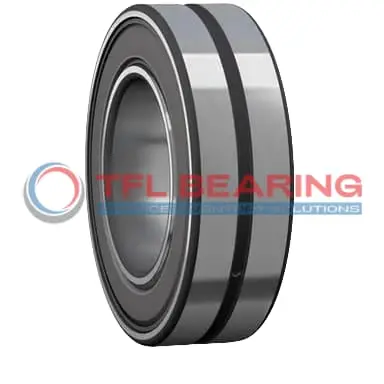
The BS2-2211-2RS/VT143 is a double-row spherical roller bearing with a 55mm bore and 100mm outer diameter, crafted from sturdy chrome steel. It handles combined loads up to 28551 lbf and runs smoothly at speeds up to 3000 RPM.
Its double-seal design keeps contaminants out while retaining lubrication, and the steel cage ensures durability. The bearing operates in temperatures from -30°C to 200°C, making it versatile for various conditions.
This model is interchangeable with SKF bearings, offering a reliable alternative for replacements. Suitable for heavy-duty applications like industrial gearboxes or mining equipment where robust performance is needed.
Weighing 1kg, it’s a solid choice for demanding environments. Compliant with RoHS and REACH standards for safe and eco-friendly use.
How Does BS2-2211-2RS/VT143 Bearing Handle Combined Loads?
BS2-2211-2RS/VT143 Bearing features a double-row spherical roller design, ideal for handling both radial and axial loads.
Its chrome steel construction ensures durability and resistance to wear under heavy-duty conditions.
The double-sealed design of BS2-2211-2RS/VT143 Bearing protects against contaminants, enhancing reliability.
With a maximum speed of 3000 rpm, it maintains performance in various industrial applications.
BS2-2211-2RS/VT143 Bearing’s lubrication groove and holes ensure consistent grease distribution, reducing friction.
Its temperature range of -30° to 200°C allows operation in diverse environments.
The steel cage in BS2-2211-2RS/VT143 Bearing keeps rollers aligned, extending service life.
Its static radial load capacity of 28551 lbf makes it suitable for demanding machinery.
Industrial Uses of BS2-2211-2RS/VT143 Bearing
BS2-2211-2RS/VT143 Bearing is commonly used in heavy machinery like crushers and vibrating screens, where its double-row design handles combined loads efficiently. The double seals help keep contaminants out, extending service life in harsh conditions.
What Makes BS2-2211-2RS/VT143 Bearing a Preferred Choice?
In conveyor systems, BS2-2211-2RS/VT143 Bearing’s spherical rollers accommodate misalignment, reducing wear and downtime. Its chrome steel construction ensures durability even under high radial loads.
Built for Heavy-Duty Use: BS2-2211-2RS/VT143 Bearing
For mining equipment, BS2-2211-2RS/VT143 Bearing’s high static radial load capacity makes it reliable in extreme environments. The lubrication groove design simplifies maintenance during prolonged operation.
Automotive vs Aerospace: Applications of BS2-2211-2RS/VT143 Bearing
In truck wheel hubs, BS2-2211-2RS/VT143 Bearing supports heavy loads while its temperature range suits varied climates. Aerospace applications benefit from its precision in auxiliary systems.
Essential Roles of BS2-2211-2RS/VT143 Bearing
BS2-2211-2RS/VT143 Bearing is ideal for paper mill rollers, where its vibration resistance ensures smooth production. The steel cage adds stability during high-speed rotations.